Friday, 22 April 2016

The Killing Fields


My stopover in Phnom Pehn was short but intense. I arrived late afternoon when all the amenities had already closed or were about to do so. So, after dropping my stuff at the hostel I took a long stroll along the Tonlé Sap river and had some dinner on the way -best papaya salad ever!

Although it's certainly not Bangkok -for the better, I dare say- I found the Cambodian capital to be more developed than expected, with locals enjoying a nightly walk along the boulevard or a beer or two beside the river bank. I went up to the night market, where the crowd was watching some local pop-stars singing on a stage in the middle of the square.

Cambodian X-factor in action

The day after, the main reason for me dropping by the capital was waiting for me: the killing fields. Of course I would have liked to do the palace and the Silver Pagoda, but since I was constrained by time, instead of being blinded by the grandeur of the empire, I turned to the human factor. And I didn't regret it.

The first thing that strikes the visitor upon entering the killing fields is how nice the site appears to be. How could such a bright, peaceful place surrounded by vegetation ever have been a place of the deepest doom and sorrow?

The Killing Fields museum

It is mainly because there is no trace of the old barracks: they were all dismantled for their much needed wood and metal when Pol Pot's regime fell. On the spots where they used to stand, there are signs depicting how the scenes might have looked then. Such a pity that the original buildings weren't preserved to remind the world of the atrocities of the past, and of the fact that they could happen again if forgotten. Maybe that's why Cambodians smile. Maybe that's why they seem to live, oblivious of their history...

A drawing depicting the prisoners crammed in the barracks

The common graves of the victims of the purges stay there though: when the killing fields turned into a museum, the bones were removed and are now on display both inside glass cabinets and the memorial stupa. New bones emerge each season when the soil is stirred by the rains, and if I looked close enough, I could distinguish among the dried leaves tiny pieces of a different sort of dried material: human bone.
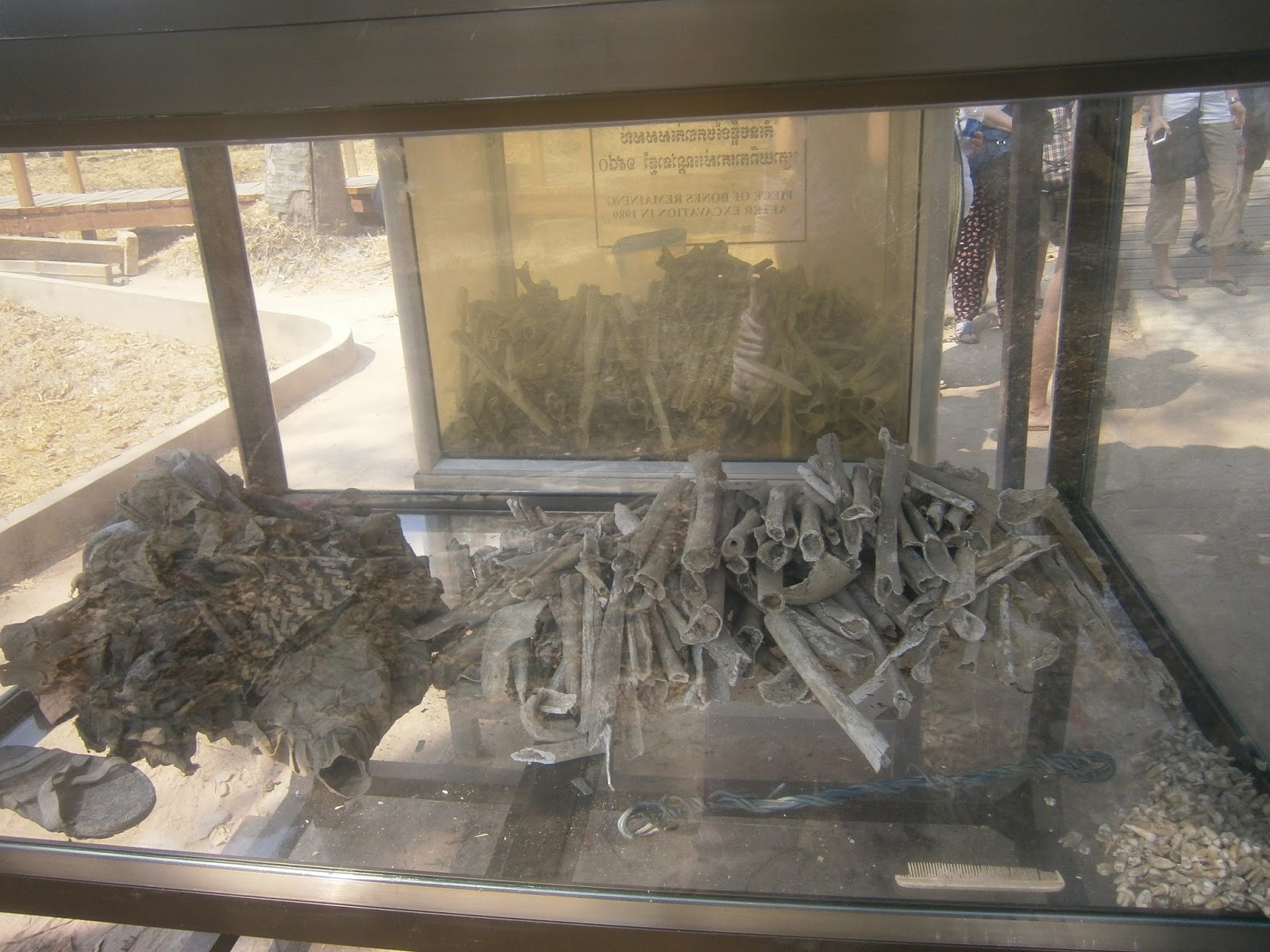
Bones disinterred from the common graves, from shinbones to jaws and teeth

Also on the common graves, the victim's clothes are perfectly distinguishable. 40 years haven't wiped them out of the earth completely. The colourful ones normally belong to children.

Rags withered by the passage of time 

Festooning the very centre of the killing fields stands a memorial stupa, built to enshrine the uncountable skulls and bones of the dead. A notice explains the weapons that the soldiers used to massacre the population -simple yet lethal ones, from hoes to wooden poles- and how to identify which one was used to kill whom by looking at the breach or hole in a given skull. 

The memorial stupa holds the remains of the victims


Broken skulls on display inside the stupa

For anyone interested in the Khmer Rouge topic, I recommend "Survival from the killing fields". It is a brutal, true story written by Haing Ngor -a survivor himself- and Roger Warner. It was later made into a Hollywood movie.

After the killing fields, to continue with the same topic, I decided to briefly visit the Genocide Museum. If it is ironic that the killing fields look almost like a park, it is even more so to imagine that this Communist prison used to be a primary school. It still preserves the original distribution, the inscriptions, and even the bars to exercise in the courtyard.

The school courtyard seen from atop one of the wings of the building


Old classrooms turned into cells, with their original beds

Luckily for me, the museum was holding an exhibition on women working in the gulags during the Pol Pot years. The Khmer Rouge gave a lot of importance to reproduction as a way to glorify the nation and spread the ideals of the regime, and they used to couple single people as they saw fit. The couples of course didn't have a say, and opposing the marriage meant death. A number of survivors, women of 50-60 years-old now, speak about their feelings towards having to take unwanted strangers as partners.


With these and many other testimonies echoing inside my head, I glumly made my way to the bus station. Back home to Battambang.

Friday, 18 March 2016

The Cardamom Mountains

The last three days of our trip we spent in the Cardamom Mountains. Bordering with Thailand to the West, this is one of Cambodia's wildest regions: enclosed by the sea to the South and by a mountain range to the North and North-East, it is said that the Khmer Rouge never managed to conquer it because of its difficult access.

Mountain landscape in Koh Kong

On our first day we stayed a backpackers guesthouse where we were greeted by a tribe of bedbugs. The worst thing was that we actually knew from a fellow traveller that the place had recently had a bedbug problem. The owner said they had got everything disinfected, but, sadly, such visitors are the kind that won't go away that easily... and they feasted on Juanjo really badly.

The next day we arranged a two-day trekking excursion to experience the wilderness in all its might. And we sure did! As we were merrily sailing away towards the starting point of our trip, little did we know what was waiting for us on the other side.

A boat took us through the lush mangroves to the starting point of our trek

Day One was just exhausting! And I have done some treks before. We went literally up the forest following the path of a ravine, climbing like mad goats over rocks, tree roots and beds of dry leaves. Me, of course, without proper footwear... All that at 35 degrees and a humidity level that made us sweat buckets.

Note for the future: Get some proper gear to hop on the mountains

After about two hours we reached the top and we stopped at a clearing for lunch. Our Cambodian guides cooked delicious fresh fish with cabbage and lemongrass while we, the pale weaklings, indulged ourselves in the pool of a nearby waterfall... full of "pedicure" fish! Did I already mention that I love them fishes?

Juanjo, our fellow trekker Jens, and our Cambodian Sherpas

After lunch we tackled the second half of the trek. Since we walked downhill most of the time, it wasn't as strenuous as the previous part. The way down was twice as tricky though, as we had to be extra careful not to slip off and break our skulls. Fun fact: Yin, one of our guides, who used to walk behind me, kept on holding up my backpack when I had to step down a slope. I guess he didn't like the idea of me reaching the bottom too fast.


Right before sunset we arrived at the farm where we were meant to spend the night. Well I think that was someone's spelling mistake, because that was certainly not a "farm", but a "barn". Our lodging was a mere stilted structure without walls equipped with a bunch of hammocks hanging from the roof. At the beginning I was glad to find a mattress, but now I think the hammock would have been a much better choice - it was rock hard, like sleeping right on the floor.

Our camping place

The morning after I got the shits, maybe caused by the series of über-natural shocks I had the previous day. I was lucky enough to find an almost western toilet built a few meters from the barn. So, the Day-Two trek was simply a series of trips from hammock to bowl for me. Not a bad plan, considering that the others came back sooner than expected because it was too hot to be walking around.

On our last day in Koh Kong -back to civilisation- we rented a scooter to go to see the Tatay waterfall. Same as with the Kampot caves, some clever countryman who happened to live on the way decided to charge a one dollar entry fee. Now, we didn't regret it at all as you can judge from the pictures:


I think I'll take a shower... 

Free acupressure massage when you sit under the stream!

And that was Koh Kong for us. We would have liked to have gone to the nearby beach after the waterfall, but we got a bad puncture on the way. So we had to lift the bike up into a tuk-tuk and take it back to the guesthouse... with the ensuing argument with the guy from the rental company about who should pay for the repairs!

Next stop: Battambang via Phnom Pehn. The country girl meets the capital! More to come in the next post... 

Monday, 14 March 2016

Kampot and Kep

Kampot, with its wide river and its French colonial architecture, is a relaxed, charming town with a flare of old "grandeur". It reminds me a bit of Battambang, but more developed. Over the past six to eight years, Kampot has become a favourite tourist stopover, and so resorts by the Praek Tuek Chuh river and quirky Western-style cafes have mushroomed around catering for the incoming flood of white-skinned globetrotters.


Our home in Kampot, the Samong guesthouse

 As most of the other southern Cambodian towns we visited, Kampot doesn't have grand, remarkable monuments –the huge durian topping one of the roundabouts is... well, original. The restored, colourful buildings from the French Protectorate age are nice too. There’s a disappointing little museum with panels explaining the history of the city and a handful of uninteresting sculptures.

The interesting sights are actually outside Kampot: the surrounding mountains and lake, its mysterious caves carved out over the years by the rain, its quirky animal figures sculpted into the limestone. 


The "elephant" cave

And of course, there is the salt marshes and the pepper fields -the Kampot pepper is actually of great quality and exported all over the world. The pepper farms can be visited free of charge and the visit usually includes a brief tour -now I know the difference between the black, red and white pepper and which one goes well with what type of food.


Volunteers sorting out pepper grains

As for the salt marshes, one can simply rent a scooter and pull over at the fields to watch the workers separating the crystals from the water and raking them up into little piles. All under the blazing sun. 


Picking up the salt at the marshes

40 km away from Kampot is the neighbouring town of Kep, which boasts a lush natural park and a beautiful coastline. Although the beach bears no comparison to the heavenly Koh Rong or Koh Rong Samloem's, it's still nice and the atmosphere is really peaceful. Along the seashore, gazebos can be rented for the day. We saw several Cambodian families gathered together for a homely meal... and the ensuing collective nap on the hammocks provided.

Siesta time beside the beach


Cheeky monkey being cheeky
But in my view, the best thing about Kep is... the Crab Market! The feast of delicious grilled fish and seafood is a pleasure for the senses. The crab ritual goes like this: you cherry-pick the freshly fished crab straight from the cage, then off it goes into the frying pan, seasoned with Kampot green pepper a-plenty. Simply mouth-watering!


Crabs: straight from the sea to the wok


The White Lady, decently wrapped up by the locals


Friday, 11 March 2016

Ha Tien

Not without feeling a little bit broken-hearted, we said “bye-bye” to the paradisiacal Koh Rong Samloen to return to the mainland. From there, we went straight away to the bus that would take us through the beautiful rice paddies to Ha Tien, the nearest Vietnamese town. Since our visas had expired some days ago, our best option was to cross the border, stay the night in Ha Tien, and re-enter Cambodia the day after.

Rice paddies on our way to Ha Tien

The trip took almost all day, but crossing the border was quick and easy. Again, you pay an extra dollar here and there for those little extras such as the mandatory “health check” –which is merely having your temperature taken- and so on…

The Vietnamese border crossing

The bus left us very close to Ha Tien’s market, a huge marketplace where you can find anything imaginable. Seafood is big in Ha Tien and you can find stalls with fresh fish from which you can choose what you want and have it cooked straight away at one of the riverside eateries.

Cockles and mussels, alive, alive oh!

Ha Tien itself doesn’t seem to have many attractions though. No pagodas, no particularly remarkable buildings other than some well kept French colonial facades. However, when you walk along the Mekong embankment, the charming views of the watery giant and the forested hills beyond make up for everything else.

The unimpressive Independence monument
Along the Mekong embankment
One thing that really struck us upon setting foot in Vietnam is that it is much more advanced than Cambodia: whereas the prices are still low, the city is cleaner and better organised, and people seem to have a somewhat better standard of living. judging by the quality of the food and what the houses look like. 


Another curious thing is that suddenly all the tuk-tuks, which are ubiquitous in Cambodia, were totally absent from Ha Tien. I can't say the same about the Communist propaganda.

Ho Chi Mihn smiles at you from every corner

The morning after we headed off to the border again, got our passports stamped and continued on to a new adventure in Kampot.


Koh Rong and Koh Rong Samloem

The next stop after Sihanoukville was Koh Rong, an off-shore island notorious for its vibrant backpacker scene. After getting off the boat, the newcomer is welcomed by a dread-locked, tattooed crowd which bides its time sipping on beer at the local pub-huts. Who can blame them? There is not a lot to do on the island apart from "chillaxing" under the sun (which is a great option, don't get me wrong). There is some zip-lining and the unexciting boat trip to watch the luminescent plankton.. There is a waterfall too, but it’s only "operational" during the rainy season.

On the slow-boat to Koh Rong

So, yes; we took the nightly boat trip to see the luminescent plankton. I reckon our minds had created really big expectations as we were hoping to see the ocean illuminated as if someone had switched on a LED light at the bottom. Nothing like that - it's more about little shiny dots scattered around when you move in the water.

The tipsy crew of the night boat was a bigger show than the plankton!

The next day we headed off to the twin island of Koh Rong Samloem, which surpasses its elder sister in beauty and quietness. If we thought that we were in paradise, well... that's because we didn't know about Koh Rong Saloem! There’s hardly anyone around, the sand is the whitest I've ever seen in my life, waters are crystal clear and their forests are pretty much unspoiled. What else could one wish for?

Stop the clocks

Through the forest, on our way to the other shore

Bungalows to let in the forest

On our second day in heaven, Juanjo and I went for a diving/snorkelling trip. We had the most amazing day. There are some breath-taking reefs at the rocky shores, full of swinging corals, buzzing with sea life of all colours and shapes imaginable. We had a really nice veggie curry for lunch and the atmosphere was really good. The only downside is my burnt bum cheeks. Mental note: one's rear needs a generous coat of sunscreen too. 

Ready to snorkel!

 Here are some more pics of the heavenly beaches. Next stop: the border crossing at Ha Tien, Vietnam!

Lazy Beach

The main pier

Selfie on the boat!


Thursday, 10 March 2016

Sihanoukville and Islands

On the evening of 4th of February we left Battambang for Sihanoukville, a touristy beach town in southern Cambodia named after the renowned politician Sihanouk, who ruled the country before the Khmer Rouge. After a month volunteering in stifling Battambang, we were ready for some sea and sun!


Otress beach in Sihanoukville

The very slow, overnight journey from Battambang to Phnom Pehn took about seven hours. We travelled in one of the famous hotel-buses -as you can imagine, I didn't get much sleep... you do feel every single bump on the road in your spine. At Phnom Pehn’s bus station, we changed buses and continued to Sihanoukville. Unfortunately, a journey of two-three hours took us almost five as we got stuck in a hell of a traffic jam when leaving the capital.


The so-called hotel-bus... No comments

Actually, from Battambang we should have gone straight to the border as our tourist visas had already expired. But we headed for Sihanoukville because Juanjo had enrolled in the yearly half marathon.
It's actually OK to go around the country on an expired visa: you "only" pay five dollars per exceeded day when renewing your visa at the border.


Juanjo ranked seventh in the half-marathon. Not too bad! :)

In Sihanoukville we spent two days lazing about on the quiet Otress beach, a real paradise on Earth dotted with wooden bungalows and boutique-style hotels. Local women walk along the beach selling a variety of king-prawn and squid skewers, and itinerant beauticians give oil massages and remove your unwanted hair right on your chaise longe... with sewing thread! Same principle as our modern electric epilators, they fold the thread in a double line and move it up and down, crisscrossing the threads at great speed. A real art!


Sunset in Otress beach