Thursday, 10 March 2016

Sihanoukville and Islands

On the evening of 4th of February we left Battambang for Sihanoukville, a touristy beach town in southern Cambodia named after the renowned politician Sihanouk, who ruled the country before the Khmer Rouge. After a month volunteering in stifling Battambang, we were ready for some sea and sun!


Otress beach in Sihanoukville

The very slow, overnight journey from Battambang to Phnom Pehn took about seven hours. We travelled in one of the famous hotel-buses -as you can imagine, I didn't get much sleep... you do feel every single bump on the road in your spine. At Phnom Pehn’s bus station, we changed buses and continued to Sihanoukville. Unfortunately, a journey of two-three hours took us almost five as we got stuck in a hell of a traffic jam when leaving the capital.


The so-called hotel-bus... No comments

Actually, from Battambang we should have gone straight to the border as our tourist visas had already expired. But we headed for Sihanoukville because Juanjo had enrolled in the yearly half marathon.
It's actually OK to go around the country on an expired visa: you "only" pay five dollars per exceeded day when renewing your visa at the border.


Juanjo ranked seventh in the half-marathon. Not too bad! :)

In Sihanoukville we spent two days lazing about on the quiet Otress beach, a real paradise on Earth dotted with wooden bungalows and boutique-style hotels. Local women walk along the beach selling a variety of king-prawn and squid skewers, and itinerant beauticians give oil massages and remove your unwanted hair right on your chaise longe... with sewing thread! Same principle as our modern electric epilators, they fold the thread in a double line and move it up and down, crisscrossing the threads at great speed. A real art!


Sunset in Otress beach

Saturday, 5 March 2016

The social circus

Cambodia is well known for its huge number of NGOs, and Battambang is home to a couple of really amazing ones. Today, let me introduce you to the social circus and school Phare Ponleu Selpak. I call it "social" because it started as an art school for deprived children and teenagers at risk. The school is still running today with an extended curriculum, since new arts as music and circus skills have been added.

Teenage acrobats found their way

The school and performing grounds are humbly located in the outskirts of Battambang. Surrounded by trees, the first thing you notice -other than the ticket booth- is a stilted wooden hut. Next to it, at the end of a footpath, there is a small marquee, where the magic happens.


The circus opens four days a week with three different shows, all of them featuring live music and traditional Khmer instruments played by the young beneficiaries. The various performances are intertwined with a central theme that brings story together. We watched "Chills", which uses the fear of ghosts -a really common fear among the Cambodians-, as the story theme.

Students peforming the traditional apsara dance

The stilted house holds an exhibition of the works of the art school students. Some of them are really talented and their artwork is even displayed and sold in the downtown art galleries. Judge for yourselves:


Changing topic completely, today is a sad day as it is officially my last day volunteering at the Coconut Water project. I had an amazingly fun and rewarding experience and I can't thank enough all the kind, fun, hard-working people -organisers, teachers, social educators, children, etc. -that made it possible. I will miss you all!


Now I'll be travelling around Cambodia for about two weeks. So the following posts will be mainly amazing sights and stunning sunsets, I hope.

Tuesday, 1 March 2016

The Floating Village

This weekend we visited the floating village of Kompong Luong. Floating villages started to emerge when Vietnamese immigrants and refugees were displaced to Cambodia. Since they were not allowed to own land, they came up with the ingenious idea of settling down on the waters of the TonLe Sap lake, between Siem Riep and Phnom Penh. I don't know for sure, but it seems like the villagers might preserve Vietnamese as a second language as I saw some books in Vietnamese in the local school.

Floating houses

If you are wondering how on earth a floating village stands together, it's pretty much a cluster of humble wooden houses, each built on a plank on top of a bunch of sturdy mobile cylinders. These allow the owners to tow their homes up and down as needed. Of course, in order to tow your home away you need a vehicle, so every household has a boat that serves as car, bike, pets toilet -yes, people have cats and dogs here too, and they poo wherever they can- or even mobile takeaway.

Grabbing a bite at a floating food "stall"

Now, these blessed villages do generate an insane amount of rubbish that, obviously, goes right into the water -the same water where they bathe, wash their clothes and use for any household activity. From cans to old fishing nets and plastic containers, daily waste piles up at the bottom of the lake and along the shores, building a disgustingly colourful landscape and dying the waters a greyish brown, sometimes coated with a bright green icing :-S 

The little ones are well used to rowing their way from home to school

When in Rome, do like the Romans. So, after arriving at the floating guesthouse we rented a boat for a leisurely ride around. Rowing our way to the local beer store wasn't as easy as it seemed: actually, the night fell upon us on our way back to the guesthouse and we got lost... While we were trying to find our bearings, we noticed that our raft was swiftly filling with water and starting to sink. We rushed to harbour at the nearest house. The family kindly "rescued" us and called the guesthouse to pick us up. The waters aren't deep -knee level maximum-, so it's not that we could have drowned or anything. But the sole thought of falling into the murky water scared us to death. If it hadn't been for those kind locals maybe we would have woken up the morning after with an extra arm from the radioactive waters.

"Rowing" down the lake

After the turmoil of our shipwreck, we had dinner and just chilled at the guesthouse porch. As I have explained in previous posts, in Cambodia there is not much to do when the sun goes down. So you can just image how it is in a floating village. Conversation soon had us wondering how people could live in a water-world and in such conditions. Most of them must have health problems caused by living among rubbish, the lack of physical activity and the long hours squatting on their little rafts... But when you think about it, is that not surprisingly similar to how we lead of lives in our cities, with our good ten hours sitting in from of a computer screen? True, we are not that prone to infections, and the feeling of being confined in a high-security prison may be much less noticeable... But, where do we draw the line? And who actually feels more like a prisoner -one of these villagers, or us?

Bonus track: wherever there's a soul, there's the Church


Thursday, 25 February 2016

How I contribute to the project

Maybe some of you are wondering what exactly do I do at Coconut Water Monday to Friday. Well, here is how I am contributing to the project:

I work 8 to 5. Almost every day I teach one or two hours of English --to the school children and/or to the Coconut Water staff. This means that quite a  good bit of my working day I spend planning lessons, looking for suitable handouts, making up games for the kids, and so on. I found out that most of the times it's just easier and quicker to create my own, since the activities need to be adapted to their different language levels and, more specifically, to their culture. It seems that localisation chases me everywhere I go (wink, wink to my work colleagues).

Teaching English at the local school

When I teach at the local school, I always go with one of the social educators, since most of the times it's not feasible to deliver the lesson in English only. Especially when learning new grammar, children normally need a brief explanation in their native language. Although they love games, children can be shy, as they are not used to expressing feelings as much as Westerners do, or to represent scenes using body language.

All in all, classes are fun... and with the adults are even funnier! :) With them, I focus on pronunciation and more complex grammar structures, and content is targeted at their own jobs and responsibilities.


English lesson with the staff
Every day I assist with communication and editorial tasks, which range from drafting short to medium articles for the English version of our website to posting on our Facebook fan page about recent activities and upcoming events. I also help the staff whenever they need me to correct their writing. In general, I gladly take on any writing tasks for which nobody else has the time, like the bi-monthly newsletter -I couldn't help but adopt it.

At the office with the social educators

Last but not least, I also lend a hand with ad hoc tasks as needed. We often visit schools and families in the so-called support visits. We are in the process of revamping our fair-trade shop, and I recently changed the design of our billboard to better publicise our restaurant: we got rid of the old-school menu to focus on the social component of the project. Judge by yourselves! I can already tell you that we are getting more attention from customers.

I know --brekkie is misspelled, but already corrected

Documenting the Bloco Malagasy vs Coconut Water match

It is also worth-noting that about 15% of my working day goes to patiently overcome bad internet connections and sluggish, overheated computers, including my own -which, to add insult to injury, has the Windows interface in Russian.

The Coconut family having lunch together


Tuesday, 23 February 2016

Siem Riep, where the Wonder of the World meets Pub Street

Last bank holiday weekend we visited the world famous, ancient city of Angkor. Angkor -which literally means "the Great City"- was built over the years by successive Khmer emperors -or better said, by their back-bent, enslaved subjects. The main monuments date from the 12th century, and they have lost their former religious role to serve a much more mundane yet lucrative purpose: they are a true cash cow, with one-day tickets priced at 20 USD (12.50 for the locals, which is a small fortune). 

The thousand faces of Bayon (actually, they depict the deified emperor; not Buddha itself)

Hello from my window!
Panoramic view of Angkor Thom

The historic site is huge and there is a fair distance between the temples so it's necessary to rent a motorbike or hire a tuk-tuk. Different in size and importance, each temple is a true piece of art, strong but delicate, and although they might all seem pretty similar at first sight, each of them has an original beauty. I like them all, but if I had to choose maybe I'd go for Bakan (the big central pram in Angkor Wat). Its breath-taking panoramic views and the tranquillity it inspires despite the visiting crowds are just priceless. I can imagine how back in the day it was a perfect place for monks to pursue the Buddha's path.

Beautifully ornamented door and lintel 
Nature vs mankind: Ta Prohm temple has been literally eaten by the trees

Yet the awe-inspiring temple complex is somewhat marred by buzzing Siem Riep: a modern, artificial settlement that serves as both sleeping hub and party town. Despite the noise and the drunken youth walking up and down in Pub Street, the Night Market is kind of nice and you can still get a good bargain and sample the local delicatessens. Oh, don't leave without trying the "fried" ice-cream --a Chinese-style ice-cream made right before your eyes on a freezing plank, then cut out in rolls. If you're wondering where is the "fried" part, well... that's just a fancy addition; there's no frying involved. 

Freshly made ice-cream

Snack at the bus station. I think I'll stick to grilled rat

And... at the Night Market in Siem Riep we bumped into the Bloco Malagasy! The Bloco Malagasy is an all-female batucada band formed by beneficiaries of the Coconut Water project in Madagascar. The girls are trained in Afro-Brazilian percussion with a double purpose: as a way of safe, healthy entertainment and to build up a skill they can use in the future. The Bloco's next stop will be... Battambang! Of course, we will be there to give them the warmest welcome. Don't miss the video I posted on Facebook! (There you will find more pics from Angkor as I'm sure you're dying to see them.

At the Night Market with the Bloco Malagasy


Thursday, 18 February 2016

Curiosities

Today I'm bringing you a series of random pics about things that just happened or drew my attention for one reason or another. Enjoy!

Since I never crave chocolate in hot weather, my addiction has been replaced by a healthier choice. I have to buy one of these every day!

Coconut water: delicious and nutritious!

Let me introduce you to Battambang's surprisingly elegant rubbish bins. They usually fill up fast, so trash keeps on piling up on the streets anyway.

A giant cooking pot of a rubbish bin

Some things are the same all over the world. In the remote Cambodian countryside, the girls are reminded that they are just not pretty enough as they are. The national female obsession is a pale skin (actually, it's hard as hell to find skin moisturiser without whitening chemicals).

Khmer women's interest magazine

Battambang is quite easy to navigate. Especially when the streets are so clearly signalled, and even broken down into fractions.

And there is also Street number 2.5

In one of our visits to poor families in the countryside, I was horrified to see this woman's mouth covered in a bloody red substance, as if someone had punched her. Then I learnt that it was just betel. It is customary for old women to chew betel nut just for the crack. They do it non-stop, hence the bloody mouth.

Old lady from the countryside

I've written before about the local alcoholic beverage, but what I didn't know is that it has an evil twin: you will need some spelling skills not to order an "Anchor" instead of an "Angkor". Not sure which one would taste worse...


Tuesday, 16 February 2016

The Bat-Cave show

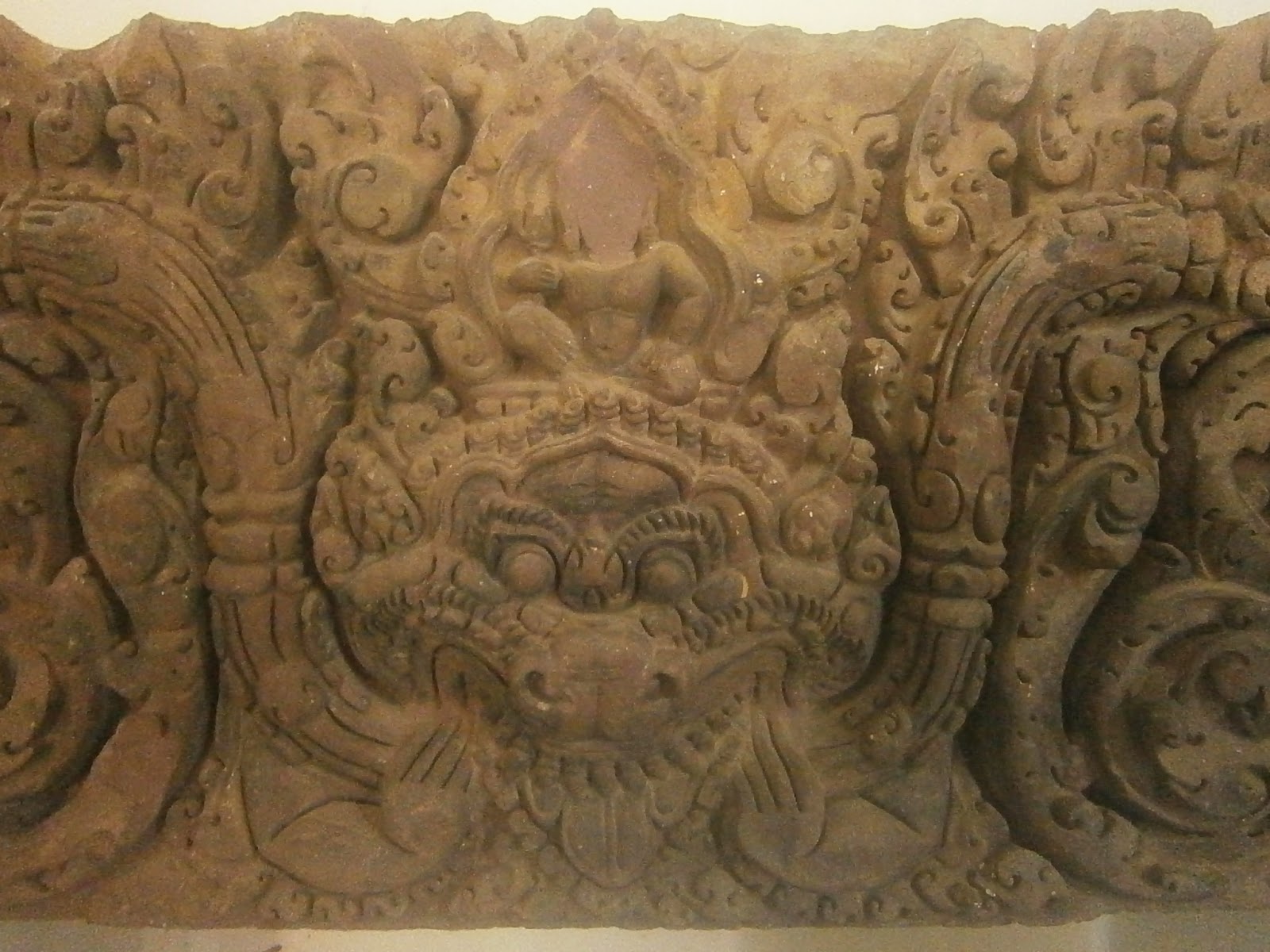
Finally, I managed to visit the Battambang Museum. I woke up earlier today to go before work -earlier by Western standards. Here the day starts at around 5pm. Although small, the museum has a good collection of sandstone lintels from the 10-11th centuries, lavishly decorated with reliefs of apsaras (heavenly dancers) and nagas (the guarding snake). There are also several fine Buddha heads and statues of Hindu deities. 


However, the most interesting part is the room dedicated to the Cambodian genocide. A series of panels explain how the people were forced to relocate from the capital and other major cities to their hometowns or to the countryside, and the brutal treatment that the Pol Pot army dispensed to them. From forced labour to torture, not to mention the systematic killing of intellectuals and people with higher education... or glasses, for the matter. Although there are no artefacts from the period, just written information, the real stories from real people are vivid and more valuable than a thousand ancient statuettes.


But, although we are not under the rule of the Khmer Rouge, one wonders how much has really changed when you see this sign on the road very fifty metres:


Even though Cambodia is a democracy now, this is pretty much the only party 


After a relatively quiet morning at the office, I had lunch at the HOC café. HOC, which stands for "Hope Of Children", is a local NGO that provides shelter to orphan children while teaching them life skills and a profession so that they can become self-sufficient. I was lured into the place because of the food, since I was told it was top-notch. And it is.The Japanese-run café is spacious, neat and tastefully decorated, apart from offering a great chance to skip the Khmer staples for a change and sample some real Japanese dishes -a rare gem in Battambang. I had the most delicious iced matcha tea, and tomorrow I will be coming back for a coffee frappe. The pictures on the walls were painted by one of the cooks -a child of the orphanage himself. If you want to learn more about the HOC project, you can find more on their website. They have volunteer opportunities (wink, wink).

The HOC orphanage

When we were back from English class, Thearout kindly offered to take me to Phom Sampeau to the bat show I went to see -but missed- last week. This is how it works: the crowd gathers at the foot of the cave and when the sun goes down -at 6.15 approximately- millions of bats dart out of their lair in a massive swarm. This natural curiosity is not to be missed... and if you are a bit late you might even still catch them as it goes on for a good twenty minutes!

The swarm on their nightly expedition to get dinner